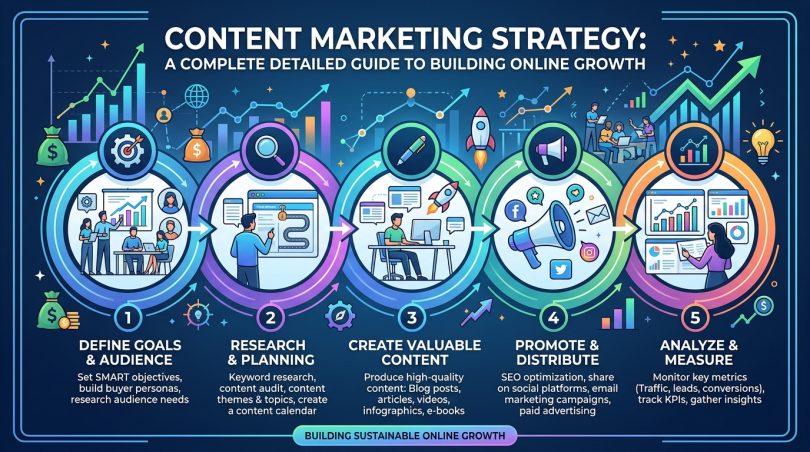

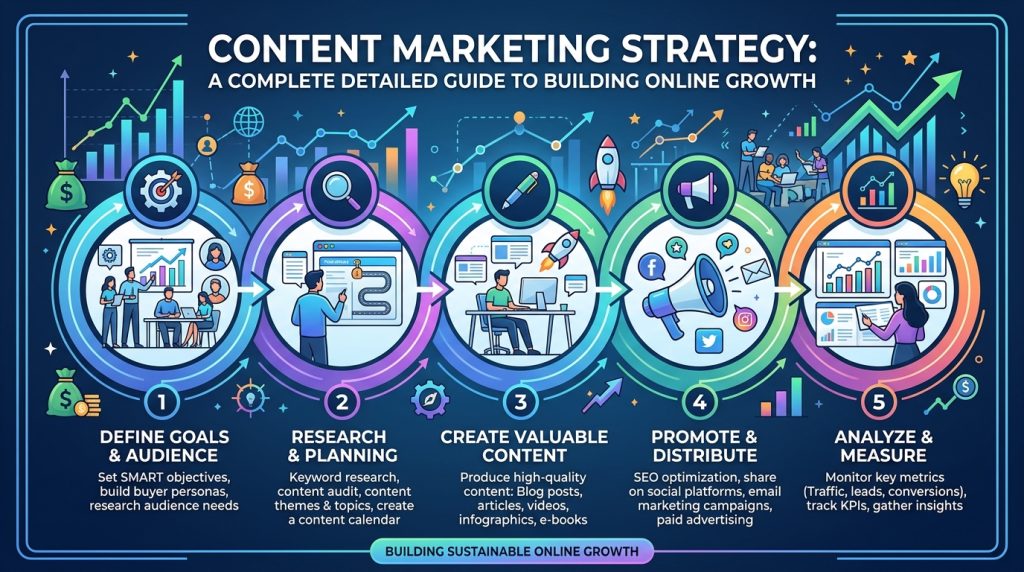
Many businesses publish content regularly and still cannot explain what it produces. Articles are written because a calendar says so, social posts are copied from competitors, and success is measured by page views that never turn into enquiries. A good content marketing strategy fixes that problem before a single word is written. It decides who the content is for, what difficulty it helps them solve, why your business is qualified to help and what the reader should do next.
Content marketing is not simply free advertising dressed up as advice. Readers can tell the difference between a helpful explanation and a sales page with a few tips attached. The businesses that win are those that teach generously, prove their claims with real examples and make the path to a product or conversation clear without pressuring people at every paragraph. Over time, that trust becomes a commercial asset that advertising alone cannot buy.
Begin With One Audience and One Problem
The most common strategic mistake is trying to speak to everyone. A guide for first-time buyers will fail experienced operators, and advanced analysis will overwhelm beginners. Choose a specific audience for each piece of content and describe the situation they are in. What have they tried? What is it costing them? What words do they use when they search for help? Customer interviews, sales calls, support tickets and search data are more useful than a vague persona invented in a meeting room.
Once the problem is clear, define the promise of the article in one sentence. A reader should know within the opening paragraphs whether the content applies to them and what they will understand by the end. This focus also makes writing faster, because irrelevant ideas become easier to cut. A strong content marketing strategy is as much about deciding what not to publish as it is about finding new topics.
Build Topics Around the Customer Journey
People need different content at different stages. Someone discovering a problem wants plain explanations, comparisons and common mistakes. Someone evaluating solutions wants evidence, prices, implementation steps and honest limitations. An existing customer wants deeper guidance, new uses and reassurance that they made the right choice. Mapping topics to those stages prevents a library full of introductory posts and nothing that helps a serious buyer decide.
Packaging offers a useful example of content moving beyond a basic product description. Our article on recyclable packaging and custom cards addresses practical questions about materials, presentation and customer expectations. A business selling a thoughtful physical product can use that kind of detailed education to explain quality, answer objections and show values in action. The content does not need to shout about the brand; it helps the reader make a better decision, and the brand benefits from being the source.
Teach Clearly and Prove What You Claim
Useful content respects the reader’s time. Use plain headings, short introductions, worked examples, checklists and specific numbers where they are available. Replace general statements such as “improve engagement” with evidence: what changed, over what period and for whom? If you do not have your own data, explain the method carefully and say where the evidence comes from. Accuracy matters more than sounding impressive.
Original experience is a major advantage. Show a process your team actually uses, include a mistake you learned from, publish anonymised results or interview a customer who solved the problem. These details are difficult for competitors to copy and far more persuasive than generic advice. Where a topic involves chance, rewards or digital purchases, honesty is especially important. Our guide to loot boxes and gacha systems demonstrates the value of explaining how a system works before asking an audience to trust it. Marketers should apply the same standard to their own claims and promotions.
Choose Formats Your Team Can Sustain
A monthly in-depth guide that your team can research properly is better than four rushed posts that say nothing new. Formats should follow the job: search articles for questions people type into Google, videos for demonstrations, checklists for implementation, calculators for decisions and email for guidance delivered in sequence. One strong piece can be adapted into several formats, but each version should add something rather than merely repeating the same script.
Create a simple production system with an owner, a deadline, a reviewer and a publishing checklist. Keep a bank of customer questions so the team is never starting from an empty page. Record sources as you research, check links before publication and update successful older articles instead of always chasing new topics. An updated guide that remains accurate can outperform a new post for years.
Distribute the Content Where Readers Already Are
Publishing is only the halfway point. Share each piece with the audience it was written for through email, relevant communities, partners, sales conversations and customer support replies. A helpful article can answer a question in a proposal, shorten a sales call or reduce repetitive support tickets. Those internal uses are part of the return on investment, not an afterthought.
Search optimisation should support the strategy rather than dictate it. Research the language customers use, place the main topic clearly in the title and headings, link related articles together and make the page fast and readable. Do not stuff a phrase into every paragraph or write for a tool instead of a person. A reader who feels manipulated will not become a customer because a keyword appeared twenty times.
Measure Actions, Not Applause
Traffic, likes and impressions can show whether content is being discovered, but they do not prove commercial value. Track the actions that matter to your business: qualified enquiries, demo requests, email sign-ups, product page visits, downloads, repeat purchases and sales conversations influenced by content. Compare topics and formats over several months, because one viral post can distort a short reporting period.
Also measure quality signals. Are readers finishing the article? Are they visiting a related guide? Are sales staff actually using it? Are customers quoting it back to you? Combine those signals with revenue data and be willing to stop producing formats that consume time without helping anyone. A content marketing strategy should be reviewed quarterly, using evidence to decide what to expand, revise or retire.
Make the Next Step Obvious and Appropriate
Every important piece of content needs one clear next step that matches the reader’s stage. An introductory guide might offer a checklist or a related article. A detailed comparison might invite the reader to book a consultation or view prices. A customer education post might lead to an advanced tutorial. Too many competing calls to action weaken all of them, while a hidden next step wastes the trust the content has earned.
Start by auditing what you already have. Identify your best-performing guides, the questions customers ask most often and the gaps between awareness and purchase. Improve those assets first, add internal links between them and give each one a purpose. A content marketing strategy that turns readers into customers is not built on volume or tricks. It is built on understanding a real problem, teaching clearly, proving your value and inviting the right next conversation at the right time.