
Synopsis:
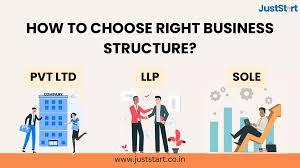
Business structures in India shape how entrepreneurs operate and grow. This article covers Sole Proprietorship, Partnership, OPC, LLP, and Private Limited Company registrations. It helps readers align their vision, funding needs, and compliance comfort with the right business structure for long-term success.
Introduction
Starting a business in India is an exciting but challenging journey, and one of the first and most important decisions is to choose the right legal structure. This option affects the company’s legal status, development opportunities, taxation and overall matching responsibility. Among the various available options, the private limited company is one of the most popular and strongest structures for registration companies. At the same time, other structures such as the sole ownership, participation company, Limited Liability Partnership (LLP), and a One Person Company (OPC) were also chosen, giving each unique benefits and limitations.
Understanding the Landscape of Business Structures in India
When starting a business in India, choosing the right structure is important as it affects taxation, liability, compliance, and growth opportunities. Here’s an overview of the main company registration options:
Sole Proprietorship
A Sole Proprietorship is the simplest and most affordable form of business registration in India. It is owned and administered by a person who is ideal for small businesses with limited capital. However, the owner can withstand unlimited liability, which means that individual property can be at risk when it comes to debt or loss.
Partnership Firm
A partnership company allows two or more individuals to run a business under a partnership agreement. With shared responsibilities and resources, registration and operation are relatively easy. However, partners have unlimited responsibility and can withstand disagreement or dissolution challenges.
One Person Company (OPC)
Introduced to support solo entrepreneurs, an OPC allows a single owner to enjoy limited liability protection while retaining full control of the business. It bridges the gap between a Sole Proprietorship and a Private Limited Company. However, OPCs are restricted in terms of turnover and cannot have more than one shareholder.
Limited Liability Partnership (LLP)
An LLP combines flexibility in partnership with the benefits of limited liability. The responsibility of each partner is limited to their contributions and protects individual assets. LLP is preferred by professionals and service-based businesses, although it requires compliance, and it cannot increase the equity financing for the company.
Private Limited Company
A private limited company is one of the most structured and popular forms of business registration in India. It provides limited responsibility, the status of a separate legal entity and high reliability in the investor and banks. With the ability to serve money and scale, it is ideal for startups and growing businesses, even though there are strict requirements for compliance.
Private Limited Company vs. Other Structures
When comparing private limited company registration with other structures, several key aspects stand out:
- Liability and legal identity play a role. A privately limited company ensures protection of limited liability and a separate legal entity, while the only ownership and participation expose owners to personal risk.
- The number of important members or founders varies. One single ownership requires only one person, the partnership requires at least two, while a private limited company can be registered with a minimum of two members and allows up to 200.
- Reliability and professional perceptions often include an inclination in favour of private limited companies. Customers, companies and investors see them as more established than ownership or partnership.
- Access to financing and investor appeal are other differences. Venture capitalists and banks prefer to invest in private limited companies because of their structured compliance, management and development capacity.
- Compliance load and cost are different. Ownership and partnerships require fewer formalities, while private limited companies include annual filing, revision and regulatory filings, making it expensive to maintain them.
- Scalability and growth potential. Private limited companies stand out, as they can expand operations, increase equity and faster on scale faster than smaller structures.
- Ownership transfer and order are also even in a private limited company, thanks to the transfer of shares, which is contrary to the ownership, where the business is directly linked to the owner.
- Taxing, although short, is the difference. Private limited companies are taxed at a fixed rate of potential incentives, while only proprietorships and partnerships are taxed according to individual rates, which may be higher.
What Should You Choose? Recommendations Based on Your Business Goals
The selection of the right business structure is one of the most important decisions for every entrepreneur. Each alternative has its benefits and limitations, and the alternative largely depends on your goals, investment plans and long-term vision. This is where a business structure corresponds to different needs:
- If your business is small in scale, choose the sole proprietorship, which requires low investment, and you will maintain complete ownership without complex compliance. With the sole proprietorship registration, you can start quickly and manage the operation independently. It is best for freelancers, small traders or businesses who do not need external money.
- Choose the partnership company if you start a company with reliable partners and want a structure that is easy to manage. A partnership company allows flexibility in joint decision-making, shared responsibility and profit sharing, making it suitable for small to medium-sized companies that depend on mutual trust.
- If you are planning to work alone, choose a one-person company(OPC), but it will still have a more structured legal status than a limited liability and ownership. OPCs provide reliability in behaviour with banks and customers, making them ideal for individual contractors for moderate growth with a professional edge.
- Select Limited Liability Partnership (LLP) to combine the flexibility of the partnership with the protection of limited liability. This option is especially useful for service-oriented companies, startups and professionals, who still want fewer demands for compliance than a private limited company, and enjoy legal security.
- Choose Private Limited Company (Pvt Ltd) if your vision is to create a scalable business, attract investors and establish strong credibility in the market. With private limited company registration, you get better access to financing, structured management and development capacity, making it the most preferred option for start-up and expanded companies.
Key Considerations
- Your long-term vision and developmental ambitions will lead the election. If you see your business as small and local, a sole proprietorship registration can be sufficient. But if you want to scale nationally or globally, structures as a private limited company provide strong growth opportunities.
- Financing strategy also means something. If you are just planning to rely on personal savings, you can work with simple forms as a partnership or OPC. However, if external investors or business capital are part of your plan, a privately limited company becomes a more appropriate route.
- Risk tolerance is another factor. In structures as the sole proprietorship, your personal property is in contact with business obligations. If limited responsibilities are important, LLP and private limited companies offer safe alternatives.
- The number of founders and team structure also affect the decision. For a single entrepreneur, the only ownership or OPC is understood. If you start with a group, LLP or a private limited company, then give a better overview.
- It should not be ignored with compliance. The only ownership and partnership involve minimal paperwork, while LLP and private limited companies require strict compliance with the submission of regulations.
- Finally, A legal or business expert can match your goals with the most appropriate structure, which can save you time, effort and future complications.
Conclusion
Choices between a private limited company and other business structures are not a decision of size passport form. Each option – either the only ownership, partnership, LLP, OPC or private limited – connects to unique benefits and limitations, depending on your vision, financing strategy and risk hunger. While simple models are ideal for small or low-risk companies, private limited company registration provides scalability, investor appraisal and long-term development opportunities. Ultimately, the right choice depends on the alignment of business goals with the most appropriate structure. Finding professional guidance ensures that you start on a strong legal basis, avoid complications and pave the way for permanent success.