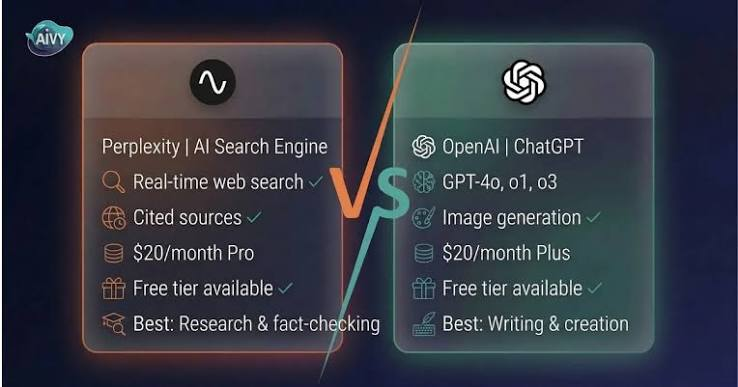

For research tasks that need cited sources, Perplexity is the stronger choice in the perplexity vs chatgpt comparison, while ChatGPT works better for open-ended conversation and creative tasks. This article breaks down the real differences we found after testing both tools side by side on the same set of research and conversational tasks.
How We Compared the Two Tools
We ran the same set of prompts through both platforms: a factual research question needing current sources, a conversational brainstorming task, and a request to summarize a recent news event. This head to head approach shows where each ai answer engine genuinely differs, rather than relying on general reputation or marketing claims.
Citation Accuracy and Source Verification
Citation accuracy is where the two tools diverge the most. Perplexity attaches direct source links to nearly every factual claim by default, making source verification simple since you can click through and confirm a claim yourself. ChatGPT, without browsing enabled, generates answers based on its training data and does not automatically cite sources, which means verifying a claim requires separate research on your part.
Real Time Search Results
For questions about current events or recent information, real time search results matter significantly. Our perplexity ai review found that its retrieval augmented search approach pulls from live web sources for most queries, giving more current answers by default. ChatGPT can also search the web when the feature is enabled, though the citation display is less prominent than Perplexity’s built-in source panel.
Chatgpt vs Perplexity Search for Everyday Questions
For everyday questions that do not require sourcing, such as drafting an email or explaining a concept, the chatgpt vs perplexity search difference matters less. In this ai answer engine comparison, both tools handle general knowledge questions competently. The gap widens specifically for questions where a source matters, such as recent statistics, product comparisons, or news events that happened after a model’s training cutoff.
If you want the full breakdown of features, pricing, and where each tool wins across different use cases, read the full Perplexity AI review for a detailed look at Perplexity’s academic mode, deep research feature, and how it compares against ChatGPT on cost.
Best AI Search Engine 2026 for Research-Heavy Work
For anyone asking which is the best ai search engine 2026 has to offer for research-heavy work, Perplexity’s default behavior of showing sources alongside every answer gives it an edge for students, journalists, and analysts. This matters especially for work where you need to trace a claim back to its origin quickly, without running a separate search to confirm what an AI tool told you.
Where ChatGPT Still Wins
ChatGPT holds an advantage in conversational depth and creative tasks. It handles longer back-and-forth conversations more naturally, remembers context across a longer session, and produces stronger creative writing output. For brainstorming, drafting, coding help, or general conversation without a strict need for sourcing, ChatGPT remains a strong and often preferred choice over Perplexity.
Pricing and Access Considerations
Both tools offer free tiers with paid upgrades that unlock more advanced features. Perplexity’s paid tier expands its research and citation capabilities further, while ChatGPT’s paid tier focuses more on access to stronger underlying models and additional usage limits. Your choice here should depend on which core strength, sourced research versus general conversation, matters more for your regular work.
Choosing Based on Your Task
The right choice ultimately depends on what you are doing. For fact-checking, research papers, or anything requiring a verifiable source, Perplexity’s citation-first approach reduces the extra step of separately confirming information. For general assistance, writing help, or open-ended problem solving, ChatGPT’s flexibility and conversational strength make it the more practical daily tool for many users.
Speed and Response Quality
Response speed was fairly close between the two tools in our testing, though Perplexity sometimes took slightly longer on queries requiring multiple source lookups, since it actively searches the web before answering. ChatGPT without browsing tends to respond faster since it draws directly from its trained knowledge rather than performing a live search first. For time-sensitive tasks where a quick answer matters more than sourcing, this small speed difference can influence which tool feels more convenient day to day.
A Note on Model Updates
Both platforms update their underlying models regularly, which can shift performance in either direction between the time of writing and when you read this comparison. Anyone deciding between perplexity vs chatgpt today should treat this article as a general framework for evaluation rather than a permanent ranking, and consider running a quick test with a recent, real task before settling on one tool for ongoing use.
Final Verdict
Neither tool is a strict upgrade over the other; they serve different core purposes. Researchers, students, and anyone who regularly needs to verify a claim benefit most from Perplexity’s source verification and citation accuracy. Writers, coders, and casual users looking for a flexible conversational assistant will likely find ChatGPT the better everyday fit. Testing both on your own typical tasks remains the most reliable way to decide which one earns a permanent spot in your workflow.